


 Login: Finland
Invoicing is often treated as the final step in a business transaction – a formality after the real work is done. But in practice, how you invoice has a direct impact on when and whether you get paid. The easier it is for your customers to pay, the more likely they are to do it on time – and the better the experience, the stronger the relationship.
This sounds straightforward. Yet many companies still send invoices that create unnecessary friction: a paper bill that requires careful manual entry of payment details, an email with a PDF attachment and a long reference number to copy correctly, or invoice handling scattered across separate systems that the customer has to seek out on their own. Every extra step is an opportunity for the payment to be delayed or forgotten – not necessarily out of bad intent, but simply because life gets in the way.
The good news is that most of this friction is removable. At Ropo, helping businesses do exactly that is at the core of what we do – and across thousands of client invoicing flows, we’ve seen that the biggest gains often come from a few targeted improvements. Here’s where to start.
Make it count when you send a paper invoice
Paper invoices are still a reality for many businesses and many customer segments. When paper is one of your invoicing channels, it should be designed to make payment as easy as possible.
A well-structured paper invoice includes all the necessary payment details in a clear, readable format – with no ambiguity about the due date, the amount, or the payment reference. But the most impactful improvements you can make are practical ones: a barcode that allows customers to pay directly through their online banking app without manually entering reference numbers or account details, and a QR code that takes them straight to a pre-filled payment view – ready to pay in seconds, with nothing to type in.
And if your invoice also reflects your brand identity – your colours, your logo, your look, and even targeted banners that guide customers toward the right actions – it reinforces trust at every contact.
A well-designed paper invoice does two things at once: it makes payment straightforward for the customer, and it reflects the care you put into every touchpoint. Getting these details right is as much about customer experience as it is about getting paid on time.
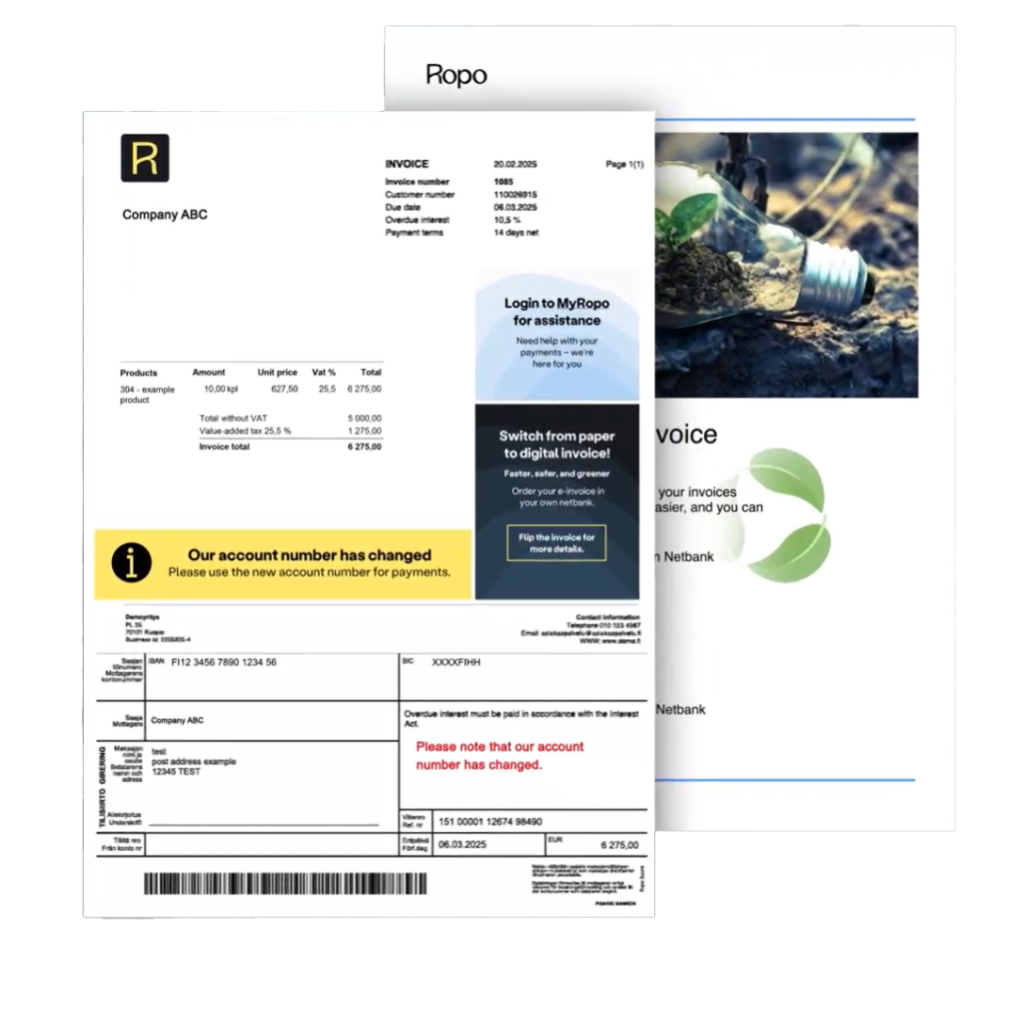

Is your paper invoice working hard enough? Check:
- Clear due date and payment reference
- Itemised invoice details with no ambiguity
- Barcode for direct payment through online banking
- QR code linking directly to a pre-filled payment view
- Your brand identity reflected – logo, colours, and look
- Your contact information visible
Get more out of your email invoices
In some industries, email is still one of the more common invoicing channels in use – yet the payment experience it delivers is often left as an afterthought. Sending a PDF attachment and expecting the customer to handle the rest is a missed opportunity.
An email invoice that includes a direct payment link removes the steps that cause delays. The customer clicks, sees the invoice, and pays – without logging in separately, without copying reference numbers, without switching between applications.
A frictionless path like this benefits both sides. For the customer, it’s simply easier. For your team, it reduces the payment queries and manual corrections that accumulate when things go wrong – a mistyped reference, a payment to the wrong account, a due date missed because the PDF went to spam.

Taking this a step further: rather than attaching a static PDF, the invoice can be delivered as a dynamic notification – the approach we take with MyRopo Invoice. Instead of a file attachment, the customer receives a notification that links directly to an up-to-date, interactive view of their invoice. The invoice details are always current, payments can be made instantly, and there’s nothing to download or manually open. For the customer, it’s a cleaner experience. For you, it means fewer queries about outdated attachments or missing payment details.
Bring invoices and payment into your own customer portal
For companies that already have a customer-facing portal or application, there’s an even more powerful option: embedding invoice and payment functionality directly into that environment.
This approach matters for two reasons. First, it keeps the customer within a familiar context – your brand, your interface, your service logic. They don’t need to navigate to a separate platform to handle their invoice. Second, instead of managing invoices in one place and order or contract information in another, everything flows together seamlessly.
When customers can view all their open invoices, make payments, set up payment arrangements, and contact support from a single place – and do it at any hour – the likelihood of timely payment increases. It also reduces the situations, where unpaid invoices stem from confusion, inaccessibility, or temporary payment difficulties rather than genuine unwillingness to pay.
At Ropo, this is exactly the kind of setup we help our clients build. Through Ropo One®, we support both lightweight integrations – such as adding a direct payment link to invoices – and more comprehensive solutions where MyRopo, with its full range of payment support features, is embedded into the client’s own portal, fully white-labelled to match their brand. Each integration level improves the customer experience: from fast, one-click payments to a full self-service environment where customers can manage payment plans, request due-date extensions, and reach support – all in one place.
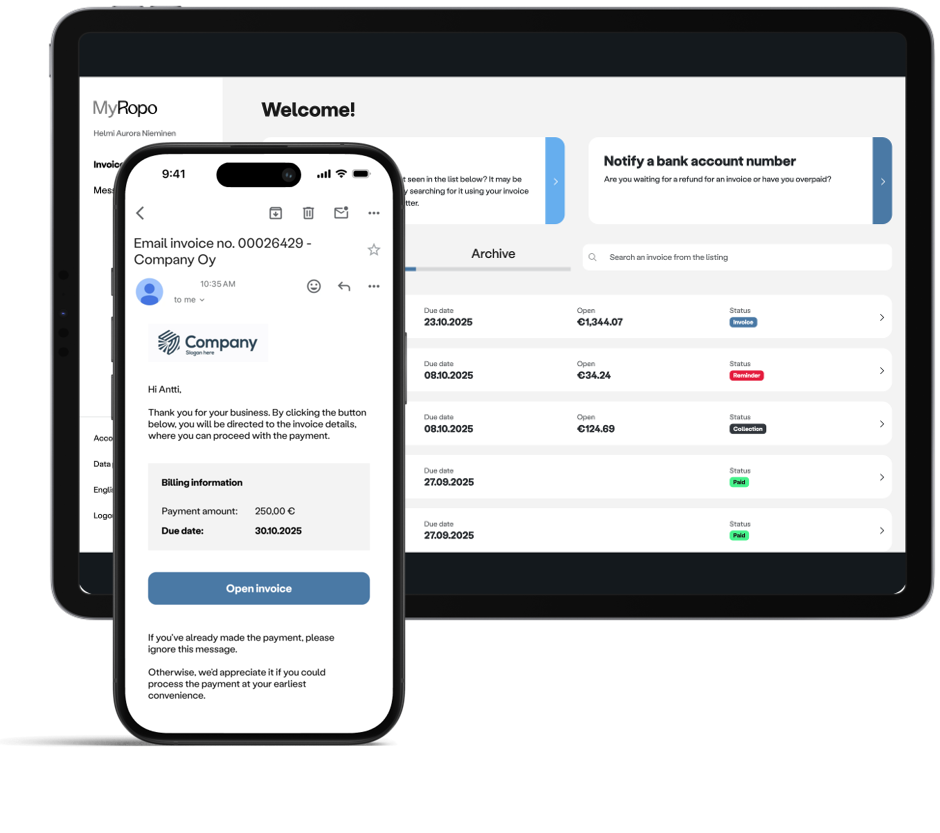
When the invoice-to-payment flow is seamless, your customers can:
- View all open invoices in one place
- Pay instantly or set up a payment plan
- Request a due date extension when needed
- Reach customer service – at any hour

The driver of healthy cash flow
Invoicing is, as a process, relatively straightforward. But it has many moving parts – different customer segments, different invoice channels, different payment behaviours. The companies that manage their cash flow most effectively aren’t necessarily the ones that chase payments the hardest. They are the ones that have made it genuinely easy to pay in the first place.
Removing friction from the invoice and payment flow is one of the most direct levers available to improve receivables performance. It doesn’t require a fundamental redesign of how your business operates – often, it’s a matter of targeted improvements to how the invoice reaches the customer and what happens next. But the strongest results come when those improvements are part of a broader mindset: rethinking every customer touchpoint along the invoice-to-cash journey, with customer experience and cash flow optimization in mind.
This is what we do at Ropo – help businesses identify those friction points and remove them, one invoicing flow at a time.

Ropo is the Nordic market leader and pioneer in invoicing technology, transforming the invoicing flow end-to-end. We help companies unify and streamline all invoicing processes to create a seamless workflow, providing full visibility, elevated customer experience, and improved control with a single overview. Committed to exceptional service and our one-platform strategy, we proudly support over 11,000 clients across Finland, Sweden, Norway, and Denmark. Read more: ropo.com
Ready to streamline your invoicing flow and enhance financial oversight?
Contact the Ropo team for a full invoice channel evaluation. We’ll help you pinpoint improvement opportunities and design the optimal setup for your customers, your processes, and your business growth.
Read more of our insights

Insights & Trends
How to Improve Cash Flow by Making Payments Easier
Read more
Insights & Trends
Inside the CFO Office: Herkko Soininen, Mehiläinen
Read more
Insights & Trends
Inside the CFO Office: Tommi Valento, Elenia
Read more
Insights & Trends