


 Login: Finland
Finance teams are no strangers to the monthly ritual: pulling payment data from one system, cross-referencing it with another, chasing down orders and delivery confirmations from a third, and compiling everything into a format that someone can actually use. The process works – but at a cost that rarely shows up anywhere in the reports it produces. At Ropo, we see this pattern across finance teams of all sizes – and we know that most of this friction is removable.
Fragmented financial reporting tends to be treated as an unavoidable feature of how finance operations work. The month-end close takes a few days. The reconciliation requires a handful of spreadsheets. The full picture emerges eventually. What’s worth examining is not whether this friction exists, but what it actually costs – and whether it needs to.
When data lives everywhere, insight lives nowhere
The challenge isn’t that finance teams lack data. Most organizations have more financial data than they know what to do with. The challenge is that financial data is typically scattered across multiple systems: invoicing in one platform, sales ledger in another, collections somewhere else, and reporting in yet another system.
For accounts receivable teams, this means manual compilation work that consumes capacity better spent on analysis. For controllers, it means reconciliation processes that are slower and more error-prone than they need to be. For the CFO office, it means that the strategic picture – where cash flow stands, where risks are building, which customer segments are paying late – arrives late, assembled from sources that don’t necessarily fully align with each other.
The costs that hide in plain sight
This fragmentation creates three types of cost that each tend to go unnoticed precisely because they don’t appear as a single visible line item.
-

The first is operational time. Every hour spent collecting, compiling and cross-checking data is an hour not spent on understanding what the data means. This is not a small inefficiency – across a finance team, it can represent a significant share of monthly working capacity, particularly around the close period.
-
The second is decision latency. Fragmented reporting delays the signals that should trigger action. When DSO trends, payment delays and receivables aging might not be visible until after a multi-step compilation process, the window for proactive intervention narrows. Payment trends that could have been addressed early become collection challenges later – and that has a direct impact on working capital.
-
The third is IT and vendor complexity. Managing financial data across multiple systems means managing multiple integrations, multiple contracts, multiple platform subscriptions, and multiple points of potential failure. The overhead accumulates quietly, but it’s real.
What unified reporting actually changes
The shift to unified reporting makes the existing process faster, and unlocks what the process can do. When all invoice lifecycle data is accessible from a single platform – updated daily, or even in real time – and structured for direct use, the nature of financial reporting changes.
Month-end reconciliation follows a predictable path rather than a detective process. Early signals on payment risk become visible in time to act on them. Finance teams spend less time on data mechanics and more time on the analysis and recommendations that create actual business value.
At Ropo, this is the foundation of how we approach financial reporting. Ropo One® Reporting integrates reporting capabilities directly into the platform, giving finance teams structured, pre-built reports across the full invoice-to-cash flow – from delivery tracking and sales invoice listings to payment control and accounting reconciliation. All reports can be exported as structured CSV/Excel datasets, making further use straightforward. Seamless integration and data‑delivery solutions ensure that data is easily available in the client’s own systems as well.
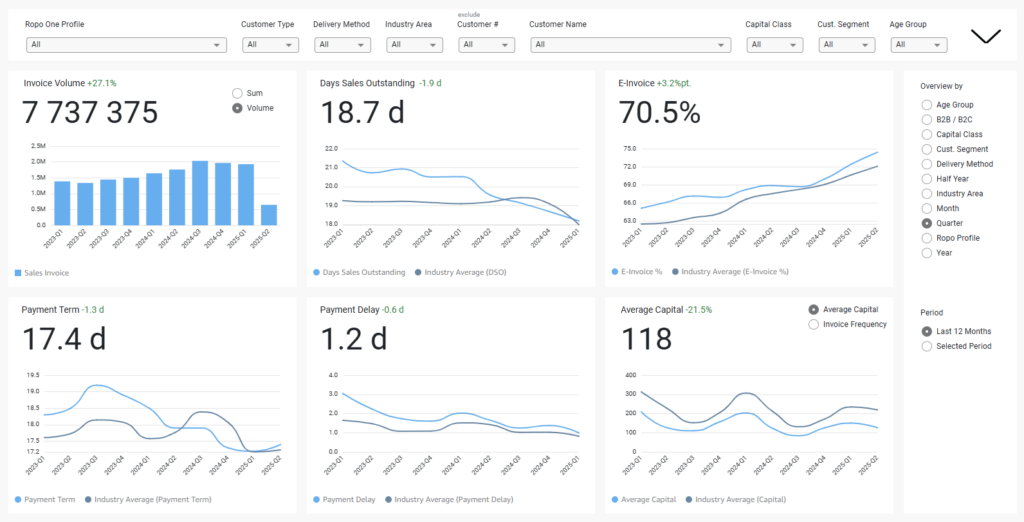
For teams that need deeper analytical capability, Ropo OneView® builds on this with a business intelligence layer: continuously updated DSO monitoring, payment behaviour analysis, receivables aging visibility and cash flow forecasting designed for controllers and the CFO office.
For organizations that need advanced risk and forecasting features, Ropo OneView® Pro extends this further with credit risk insights and smart forecasting.
The point isn’t that every organization needs all layers. It’s that the right level of reporting capability should match the actual needs of the team using it – and that all three sit within the same platform, without adding integration complexity.


Ropo's reporting capabilities – a level for every need
Ropo One® Reporting – included in the platform
Structured, pre-built reports covering the full invoice-to-cash flow: delivery tracking, sales invoice listings, payment and settlement reporting, open receivables, accounting reports, and service invoicing. Updated daily, with flexible filtering and export capabilities up to one million rows. All reports can be exported as structured CSV/Excel datasets. The operational foundation for accounts receivable teams and finance operations.
Ropo OneView® – advanced analytics add-on
Continuously updated KPI dashboards for cash flow monitoring, DSO tracking, payment behavior analysis, and receivables aging visibility. Designed for controllers and the CFO office who need strategic oversight alongside operational data.
Ropo OneView® Pro – advanced risk and forecasting
Extends Ropo OneView® with credit risk insights and smart forecasting for organizations that need deeper analysis of payment behavior, receivables risk, and forward-looking cash flow modeling.
Ropo One® API & data delivery service
Seamless integration between Ropo One® and the client’s system ensures that invoice status information is always up to date. The data delivery solution provides smooth and reliable transfer of reporting data from Ropo One® into the client’s preferred tools.
From reactive to proactive
The operational benefits are real – less manual work, faster closing, fewer errors. But the more significant shift is in how finance teams can operate when they have reliable, current data available when they need it.
Controllers who aren’t spending time on data compilation can focus on identifying the trends and risks that inform better decisions. Accounts receivable teams with continuously updated visibility into open receivables can act on early signals rather than late ones. The CFO office gets a picture of cash flow and payment risk that’s based on actual data, not estimates pieced together from multiple sources.
Fragmented reporting is a structural constraint on how effectively a finance function can operate. The hidden costs it creates – in time, in decision quality, in working capital – are real, even when they don’t appear on any single report.
Removing that constraint is usually more straightforward than it seems. It starts with a simple question: where does your financial data actually live, and how long does it take to bring it together?

Ropo is the Nordic market leader and pioneer in invoicing technology, transforming the invoicing flow end-to-end. We help companies unify and streamline all invoicing processes to create a seamless workflow, providing full visibility, elevated customer experience, and improved control with a single overview. Committed to exceptional service and our one-platform strategy, we proudly support over 10,000 clients across Finland, Sweden, Norway, and Denmark. ropo.com
Ready to streamline your financial reporting?
Ropo One® provides comprehensive, pre-built reports designed specifically for finance operations. Interested in exploring how to get the most value from your financial data? Our team is here to help.
Contact the Ropo team to learn more about Ropo One®’s reporting capabilities.
Discover more of our insights

Insights & Trends
The Hidden Cost of Fragmented Financial Reporting
Read more
Client stories
Broman Group Streamlined Its B2B Invoicing with Ropo
Read more
Services & features
Ropo One® Product Updates – March 2026
Read more
Insights & Trends