


 Login: Finland
Every stage of the invoicing process carries a cost. Creating and delivering invoices, managing the sales ledger and monitoring payments, following up on overdue accounts, and reconciling receivables. Some of these costs are easy to see: printing, postage, platform licenses, and integration fees. Others are harder to spot, spread across manual hours, delayed payments, scattered systems, and decisions made without the full picture. At Ropo, we help CFO Offices across the Nordics bring these less visible costs into view – and remove them where it matters most.
Here are five places where invoicing costs commonly build up, and what addressing each one looks like in practice.

1. Manual work takes time away from higher-value tasks
Manual work is an obvious cost in any invoicing process. But the bigger question is how much of your team’s time is tied up in routine work across invoicing, payment monitoring, sales ledger management, reporting, and cash flow forecasting. When these processes rely heavily on manual input, valuable capacity is spent on repetitive tasks instead of analysis, decision-making, and other work that creates greater value for the business.
The opportunity lies in reducing that routine workload through automation and outsourcing. Automated payment matching, structured exception handling, self-service options for common customer questions, and outsourced sales ledger operations can all reduce the amount of manual work required throughout the invoicing flow.
Depending on how far a company takes automation, clients in our network report freeing up 30% to 100% of the manual work previously tied up in invoicing and sales ledger operations – time that can instead be directed toward analysis and decision-making.
2. Every day of DSO has a price tag
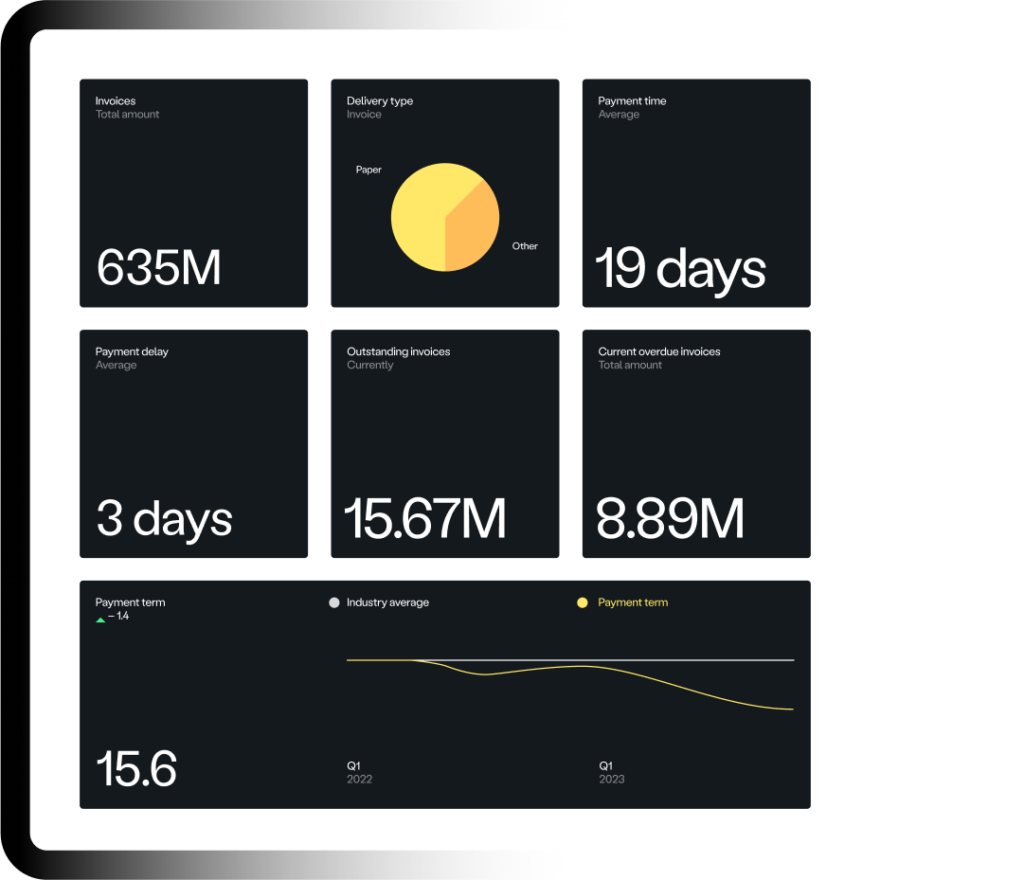
Days Sales Outstanding (DSO) can be viewed as an operational metric, but it’s also a direct financial one: every day that capital sits in receivables instead of the bank account is a day it isn’t available for the business to use. For a company with €50 million in annual revenue, a 3-day improvement in DSO translates to roughly €53,000 in annual financing savings, calculated using a 13% weighted average cost of capital (WACC).
This isn’t theoretical. Across Ropo’s client base, the average improvement in DSO is 3 days. Two examples, A-Katsastus Group and Oomi, both achieved a 3-day improvement through targeted process changes – one by unifying a fragmented, multi-partner invoicing flow, the other through real-time visibility into payment behavior. Different starting points, same result: capital freed up faster.
Read how Nordic companies improve cash flow and reduce DSO
3. Fragmentation has a coordination cost
Many CFO Offices still manage invoicing processes that are split across separate systems, partners, and process phases – from invoice delivery and sales ledger management to reminders and collections. Every connection point between systems, providers, or workflow stages introduces additional coordination, increasing the risk of delays, inconsistencies, and gaps in visibility across the invoicing flow.
This cost of coordination accumulates quietly in IT time, vendor management, process oversight, and the additional work required when systems and data handoffs don’t fully align.
Bringing these functions together on a single platform and into one streamlined workflow simplifies vendor management, reduces process fragmentation, and removes much of the reconciliation work needed to make separate systems and processes work together.
Dive deeper on the hidden cost of fragmented financial reporting
4. Digital invoicing: faster payments, easier experience
The invoicing channel has a direct impact on how quickly payments reach your account. According to Ropo’s payment behavior data across the Nordics for the past 12 months (Q4 2025–Q3 2026), digital invoices were paid 1.5 days earlier in B2B transactions and 4.6 days earlier in B2C transactions compared with paper invoices, measured as the average delay after the due date.
Increasing the share of digital invoicing can therefore have a measurable impact on payment speed and cash flow. For businesses still sending a significant share of invoices on paper, shifting customers toward digital channels represents a practical opportunity to accelerate incoming payments.
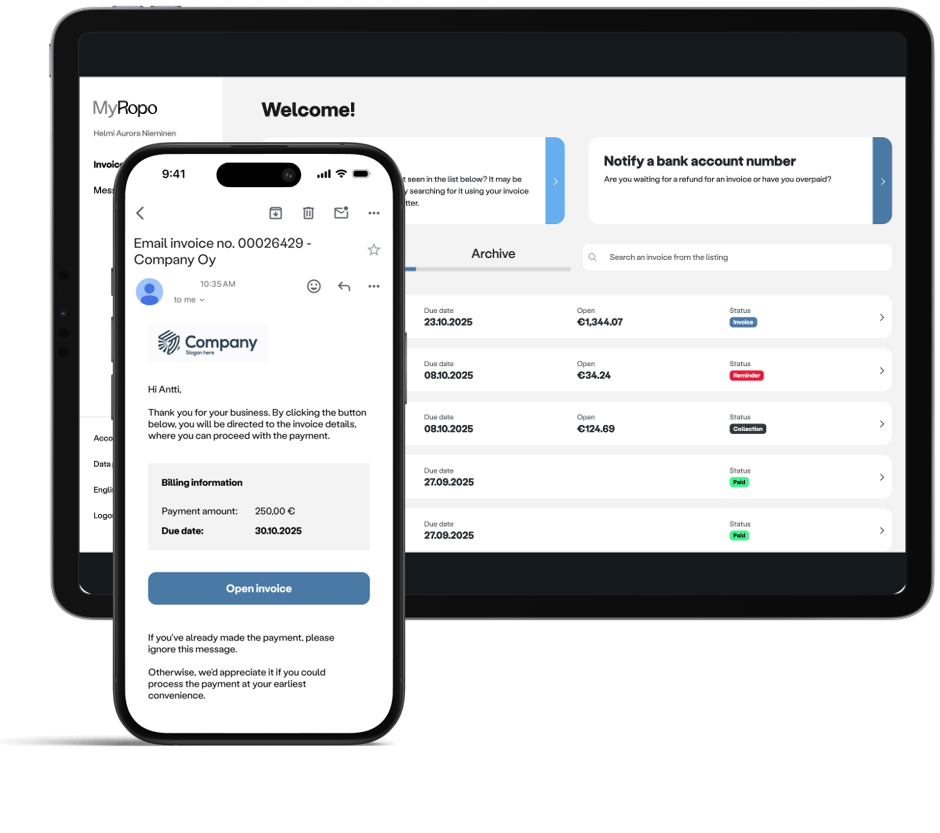
There’s also a customer experience side to this. End customers are more likely to pay on time when they can do so through a channel they already know and prefer – their online banking app, a direct payment link in an email, or a portal they already use – rather than being redirected somewhere unfamiliar to figure out how to pay. Fewer steps between receiving an invoice and paying it means fewer delays, fewer support queries, and a better experience on both sides.
Discover how to improve your cash flow by making payments easier
5. What you can see, you can control
The costs above are easiest to fix when they can be seen. When invoicing data is scattered across systems, spotting a rising DSO trend, a payment delay pattern, or a growing reconciliation backlog often happens too late to act on it proactively.
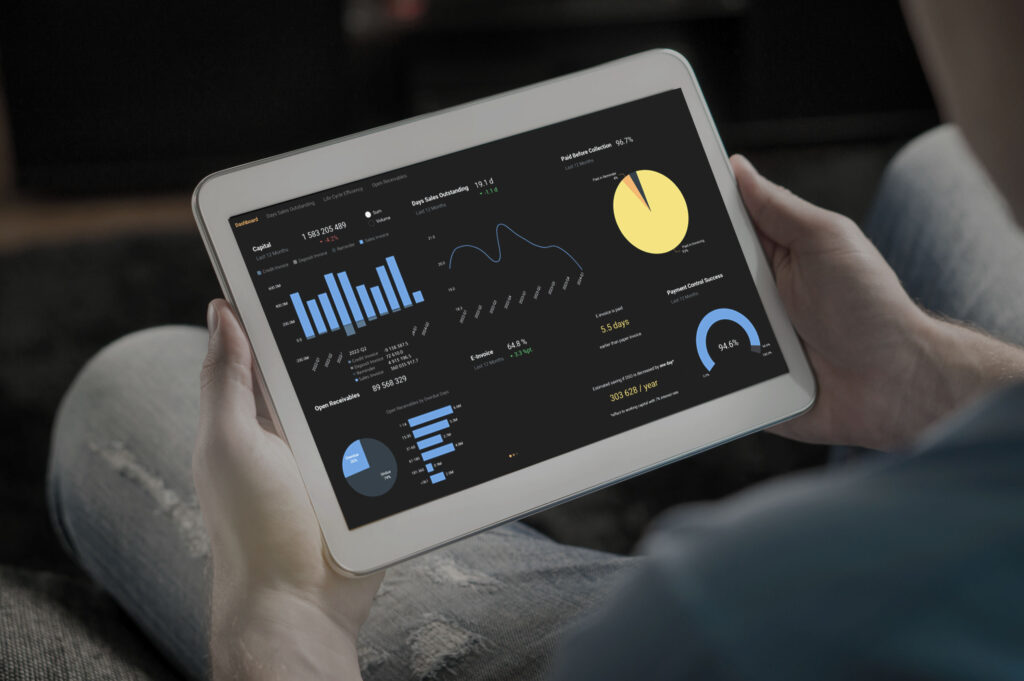
With a single, 360-degree view across the entire invoicing flow – updated in real time – these signals surface while there’s still time to respond, rather than showing up as a surprise in next month’s close. Cost control stops being an occasional clean-up project and becomes part of how the finance function operates day to day.
Learn more about real-time financial visibility with Ropo OneView®
The sum of its parts
None of these five areas exist in isolation. Reducing manual work can improve DSO, digital delivery reduces fragmentation, and visibility ties it all together. This is the thinking behind the Ropo One® single-platform approach: bringing invoice delivery, sales ledger management, reminders, and collections into a unified flow on one platform, with real-time reporting through Ropo OneView® for teams that need deeper visibility into what’s driving their numbers.
In Ropo’s H1 2026 decision-maker survey, cost savings was named by CFOs as a measurable bottom-line benefit of bringing invoicing operations together on a single platform.
Individually, these costs are easy to overlook. Together, they can represent some of the more accessible levers available to the CFO Office for improving financial performance once they are brought into view.
Ready to see where your invoicing costs are hiding?
Contact us to talk through where the biggest savings potential is in your own invoicing process.

Ropo is the Nordic market leader and pioneer in invoicing technology, transforming the invoicing flow end-to-end. We help companies unify and streamline all invoicing processes to create a seamless workflow, providing full visibility, elevated customer experience, and improved control with a single overview. Committed to exceptional service and our one-platform strategy, we proudly support over 10,000 clients across Finland, Sweden, Norway, and Denmark.
How Nordic market leaders improved efficiency and cash flow
What if invoicing could accelerate your financial flow?
Subscribe to our 3-email case series to see how companies like Caruna, Strawberry, and Bodø Energi streamlined their invoicing, reduced manual work, and boosted financial visibility – all through Ropo’s proprietary platform.
Three stories. Three strategies. Delivered directly to you.
Read more

Insights & Trends
5 Hidden Costs in Your Invoicing Process – and How to Fix Them
Read more
Insights & Trends
Inside the CFO Office: Tommie Rudi, Skandia Greenpower
Read more
Insights & Trends
Ropo One® – Where Technology Meets Expertise
Read more
Insights & Trends