


 Login: Finland
A single invoice can generate around 100 individual data points as it moves from creation to delivery, payment and beyond. Along the way, it provides valuable insights into cash flow, customer behavior and operational performance that support better decision-making.
To take a closer look at how businesses can unlock the value of invoicing data, we spoke with Niko Pylkkänen, Ropo’s Head of BI & Data, about the insights it provides and how to put them into practice.
One invoice tells you about one transaction. But across customer segments and the entire invoice volume, individual transactions start revealing patterns. You can see how different customer groups pay, build more meaningful segmentation, and identify the factors influencing cash flow and risk.
The real value comes from connecting individual data points and analyzing patterns across the invoice lifecycle.
A late payment, for example, is not an isolated event. It can be seen in the context of the customer group, invoice delivery channel, payment history and any contact that followed. These connections help businesses understand not only what happened, but what may have influenced the outcome.
Comparing different payment journeys can reveal what drives positive payment behavior and where those learnings can be applied more broadly.
When the entire invoice-to-cash process is managed on a single platform, both the amount of data readily available and its value multiply.
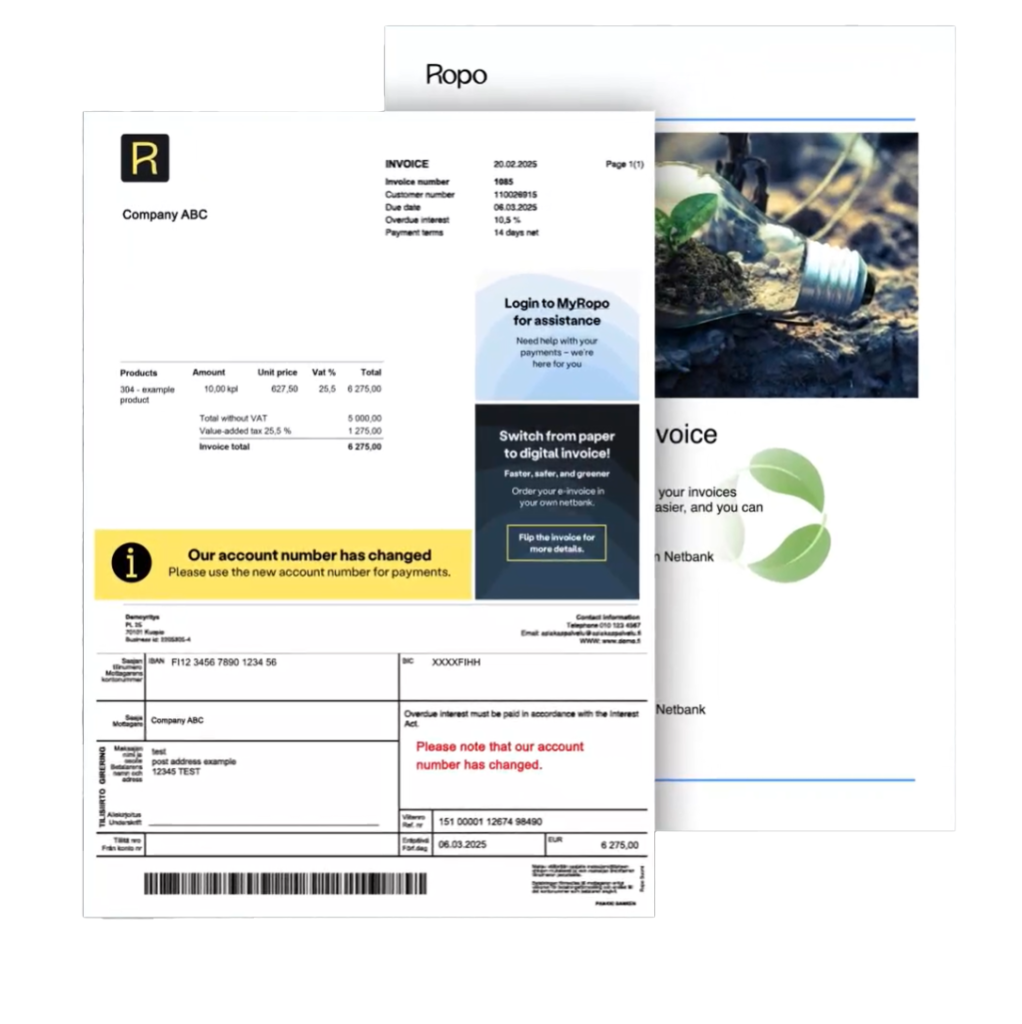
Instead of stitching together fragmented pieces of information scattered across separate systems, businesses have a more complete view across the invoice lifecycle, from invoices paid on time to those paid late, and can better analyze what distinguishes one payment journey from another.
This provides a strong foundation for deeper customer understanding, more accurate cash flow forecasting and better-informed business decisions.
From data visibility to informed decisions
Having access to data is the starting point. Turning it into meaningful insights requires the right tools and expertise.
As Niko explains, Ropo’s extensive invoice volumes provide a valuable foundation for understanding customer behavior and improving the invoice lifecycle.

“Across the Nordics, we deliver over 160 million invoices and other documents annually on average. Each delivery adds to the data our clients can use to better understand different customer groups and delivery channels, and ultimately optimize the invoice lifecycle,” Niko explains. “Ropo One® is designed as a data engine: better decisions are powered by better data. But data itself can be tricky. Analyzing and interpreting it takes time, and doing it well requires expertise.”
That is why making data available is not enough. It needs to be transformed into a form that supports day-to-day management, reporting, monitoring and longer-term planning.
“We process the data into easy-to-use dashboards and clear KPIs. Ropo One® provides each client with their data in a ready-to-use format, with clear trend graphs, visualizations and key figures. This makes it easier to understand what the data is telling you and how to use it in decision-making and planning.”
Niko Pylkkänen, Ropo’s Head of BI & Data
For Ropo clients, everyday reporting is available through Ropo One® Reporting, while Ropo OneView® provides deeper analytics and insights. Clear, accessible reporting helps finance teams understand what is happening, identify areas that need attention and make informed decisions about the next steps.
“Around 100 data points from a single invoice may sound impressive, but the number itself isn’t what matters. The value comes from connecting that data across the invoice lifecycle and using it to understand what’s happening, why it’s happening and what you can do differently as a result.”
Turn insights into action
The value of invoicing data becomes particularly tangible when insight starts shaping what happens next. Payment behavior patterns and customer data can inform segmentation, with different rules and thresholds applied to different customer groups and delivery methods.
This means that the journey from invoice to payment, including schedules and actions following late payment, does not have to follow the same path for every customer.
Niko explains how Ropo puts data into action through Ropo One®, the engine powering invoice lifecycle management end-to-end:
“Ropo One® is basically a huge, automated decision-making machine. Every decision made in the invoice lifecycle process can be based on data and best practices.”
Data does more than provide visibility to clients. It also informs how the service operates behind the scenes. Data is used to configure automation, allowing the process to respond systematically to different situations.
“Ropo One® enables up to 99% end-to-end automation across invoice-to-cash management. With segmentation, rules and thresholds guiding the process, even complex routines can be handled automatically, while predefined steps can require human review or approval,” Niko explains.
This is where data and automation reinforce each other. Data helps determine how the process should work to best support clients’ needs, while automation puts those decisions into practice consistently and at scale.
The same data can also support commercial and credit decisions. Payment behavior provides a continuously developing view of an existing customer relationship. Combined with third-party credit information, changes in payment behavior can help identify emerging credit risk earlier. Other patterns can reveal opportunities within the existing customer base and provide insight into prospective customers.
Importantly, this understanding can develop continuously throughout the customer relationship rather than being limited to a credit assessment when a customer is first acquired.
Benchmarking turns data into context
Knowing that days sales outstanding (DSO) has changed or that customers receiving invoices digitally are paying faster is valuable. But is your DSO actually high? Is the change unique to your business, or does it reflect a broader trend? Without context, even accurate data can be difficult to interpret.
This is where the scale of Ropo’s data provides a broader perspective.

“The more data you can use, the better the context. In Ropo OneView®, we provide benchmark data that allows our clients to compare their KPIs with industry averages. This helps them understand whether their figures are already at a good level or whether there are clear differences compared with the benchmark,” Niko explains.
Benchmarking turns an isolated KPI into something more meaningful. It can help businesses distinguish between patterns specific to their own operations and broader developments, giving finance teams a stronger basis for deciding where attention can have the greatest impact.
It also creates an opportunity for best-practice sharing. Instead of treating invoice workflows as static internal processes, businesses can draw on Ropo’s broader data and insights to continuously evaluate how their segmentation, automation and process configurations could be developed.
As data accumulates, the picture becomes richer. Payment patterns emerge, seasonal trends become easier to recognize, and changes in customer behavior can be viewed in a longer-term context.
“Data on its own does not move a business forward,” Niko concludes. “Numbers need interpretation, patterns need context and insights need action. The goal is not necessarily more data. It is having the right data available across the invoice lifecycle and using it to make better decisions.”
Ropo in numbers
The scale behind the data provides some perspective:
- ~166 million invoices and other documents handled annually on average (2021–2025)
- Around 100 data points generated per invoice
- 1.6 million+ end-customer service contacts*
- 2.4 million MyRopo user sessions*
- 1.2 million Ropo One® user sessions*
- Up to 99% automation in invoice-to-cash management
- 10,000+ clients across the Nordics

*2025 figures
Every data point is a building block of insight. Connected across the invoice lifecycle and interpreted in context, together they power the decisions that move businesses forward.
Ready to see what full visibility looks like in practice?
Ropo One® provides continuous visibility and actionable insights across the entire invoice lifecycle, helping finance teams make informed decisions and improve their processes. Get in touch to explore what that could mean for your business.

Ropo is the Nordic market leader and pioneer in invoicing technology, transforming the invoicing flow end-to-end. We help companies unify and streamline all invoicing processes to create a seamless workflow, providing full visibility, elevated customer experience, and improved control with a single overview. Committed to exceptional service and our one-platform strategy, we proudly support over 10,000 clients across Finland, Sweden, Norway, and Denmark. Learn more about Ropo at ropo.com.
How Nordic market leaders improved efficiency and cash flow
What if invoicing could accelerate your financial flow?
Subscribe to our 3-email case series to see how companies like Caruna, Strawberry, and Bodø Energi streamlined their invoicing, reduced manual work, and boosted financial visibility – all through Ropo’s proprietary platform.
Three stories. Three strategies. Delivered directly to you.
Read more
Insights & Trends
How to Use Invoicing Data to Make Better Business Decisions
Read more
Insights & Trends
ViDA and the Future of Invoicing: What You Should Know
Read more
Insights & Trends
What Does Invoice Lifecycle Mean?
Read more
Insights & Trends
